Leadership:
Accountability & Transparency
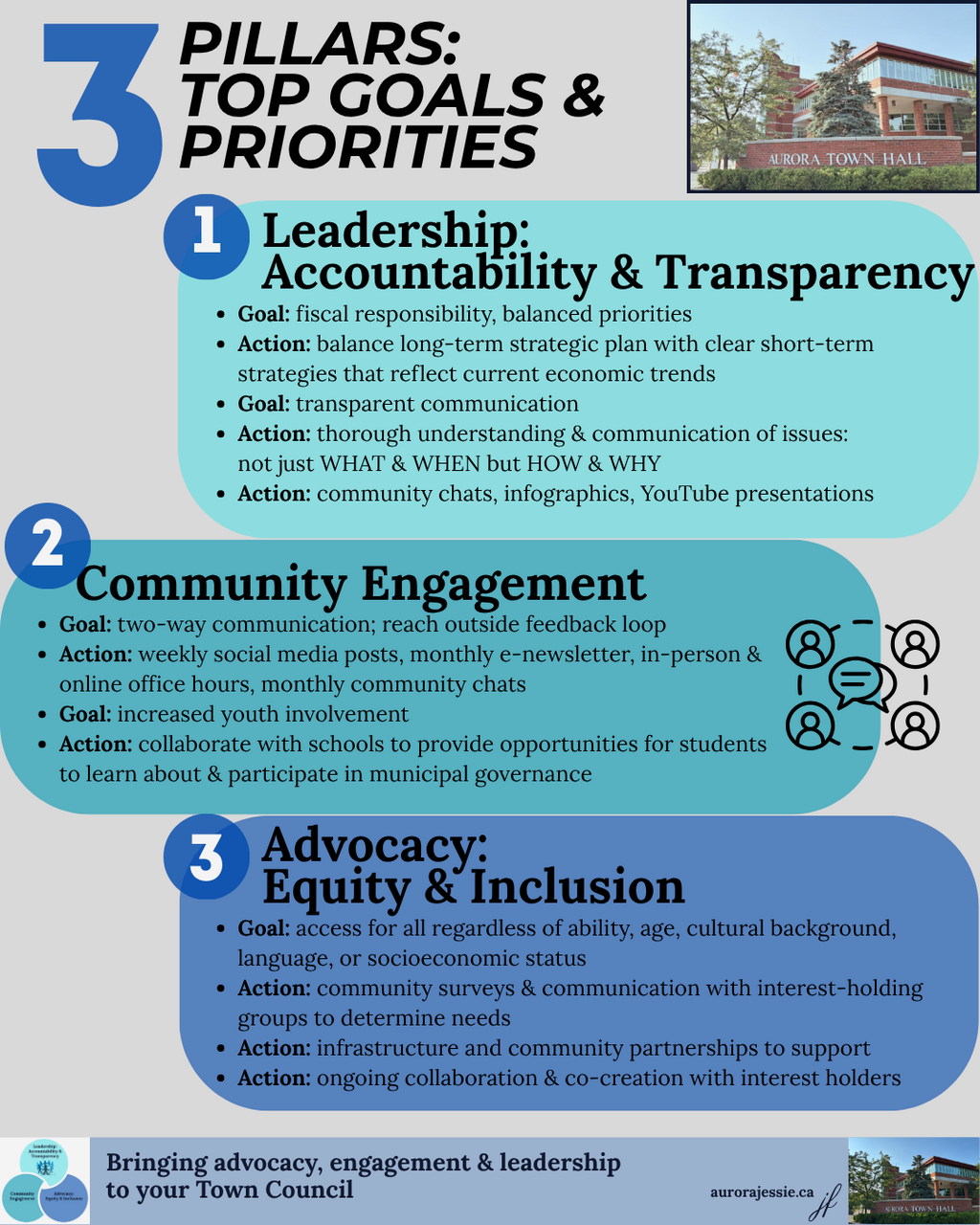
- Goal: fiscal responsibility, balanced priorities
- Action: balance long-term strategic plan with clear short-term strategies that reflect current economic trends
- Goal: transparent communication
- Action: thorough understanding & communication of issues: not just WHAT & WHEN but HOW & WHY
- Action: community chats, infographics, YouTube presentations
Community Engagement
- Goal: two-way communication; reach outside feedback loop
- Action: weekly social media posts, monthly e-newsletter, in-person & online office hours, monthly community chats
- Goal: youth engagement & involvement
- Action: collaborate with schools & community groups to provide opportunities for students to practice leadership skills & participate in municipal governance
Advocacy:
Equity & Inclusion
- Goal: access & inclusion for all regardless of ability, age, cultural background, language, or socioeconomic status
- Action: community surveys & communication with interest-holders to determine needs
- Action: infrastructure and community partnerships to support
- Action: ongoing collaboration & co-creation with interest holders; mutual teaching & learning
Communication and collaboration are how we co-create the kind of community we all want to live in.
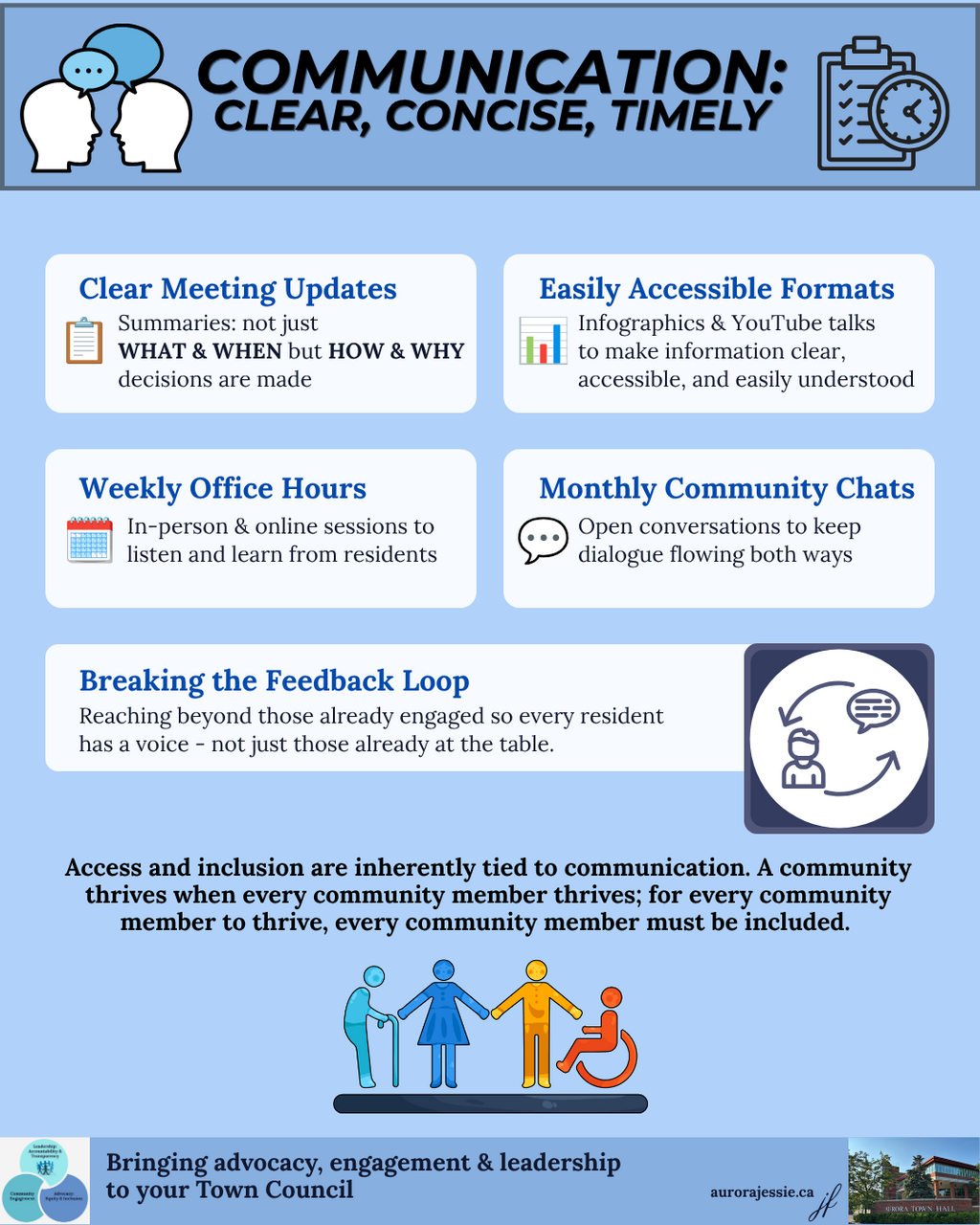
This is an area where my education and professional experience will serve well. The community requires clear, accurate, and timely information: not just WHAT & WHEN but HOW & WHY decisions are made, questions are asked, and votes are cast. A lack of this kind of clear communication has led to a dramatic increase in misinformation, particularly in online forums. As Councillor, I will summarize information for the community following every committee & countil meeting in easily accessible formats including infographics - like the ones shared on this page - and YouTube talks like those on my capaign channel to ensure that information being disseminated is both accurate & understood.
Two-way communication is also critical. As Councillor, I will post information for the community on social media & community boards regularly and engage with residents' responses. I will host in-person and online office hours weekly to listen to & learn from residents and monthly community chats to ensure that as a representative of the community I have an understanding of residents' wants & needs.
I have also noticed feedback loops in existing Town communication - despite an organizational commitment to community engagement, feedback and participation are cyclical and self-reinforcing. Input comes from those already active in the community: those participating in and included in activities, conversations, events, and programs tend to be the ones who further engage, creating a feedback loop where those already included have a voice and those without access or awareness do not. My goal is to include all members of the community in communication and ensure that all voices are heard.
Access and inclusion are linked to communication. A community thrives when every community member thrives; for every community member to thrive, every community member must be included. Want more details? Check out my YouTube channel!
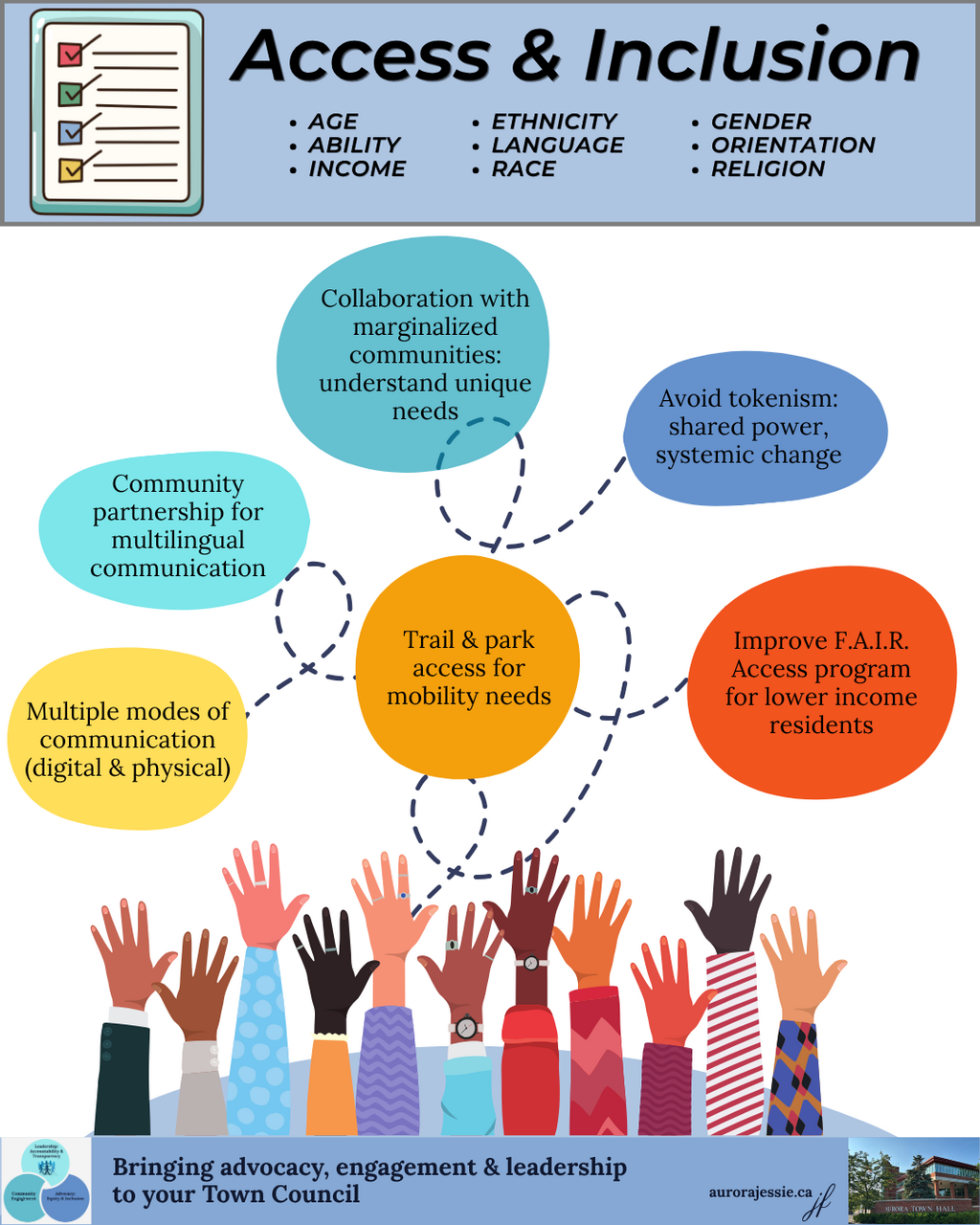
Access & Inclusion: The Aurora community is woven together by citizens with a diversity of abilities, cultural backgrounds, languages, and lived experiences. I believe the fabric of our community is strongest when everyone has access and is both included and informed, so I prioritize communication and collaboration. Every community member must be able to access programs & services that serve their needs regardless of age, ability, ethnicity, language, or socioeconomic status. To achieve this, I will use community surveys, communicate with interest-holding groups to determine wants & needs, build partnerships, and propose changes required to support those wants & needs.
Inclusion extends beyond simple access. What about lower-income residents? Aurora offers an income-based subsidy program for camps and recreation programs - the F.A.I.R. Access program - but its eligibility threshold is low and the maximum amount allotted is inadequate for many families in need. One week of Town-run camp, for instance, costs the same as the maximum full year allotment for an eligible child - not including the cost of before or after care. Many families use summer camp as a child-care option - but for lower-income working parents this becomes an impossible situation.
What about marginalized residents? Asian, Black, and Indigenous residents; Jewish, Islamic, and Sikh residents; members of the 2SLGBTQ+ community; are the unique and distinct needs of all community members being considered from the perspective of those community members, or are they merely being acknowledged with a flag, a recognition day, a photo opportunity? What about older adults? Aurora has an incredible trail system, but as many older residents in Ward 5 have pointed out to me, they are unable to safely use the unpaved gravel trails that are steps from their doors because they require a stable surface. What about communication? The primary form of communication for the Town is social media and the primary language is English, but what about older adults who may not be on social media or newer Canadians for whom English might be a 2nd or 3rd language?
Collaboration, co-creation, and mutual teaching and learning with diverse communities is critical to understand community needs and build partnerships to work toward meeting those needs. This is an area in which my years of experience in collaborative equity work will serve the community. Want more details? Check out my YouTube channel!
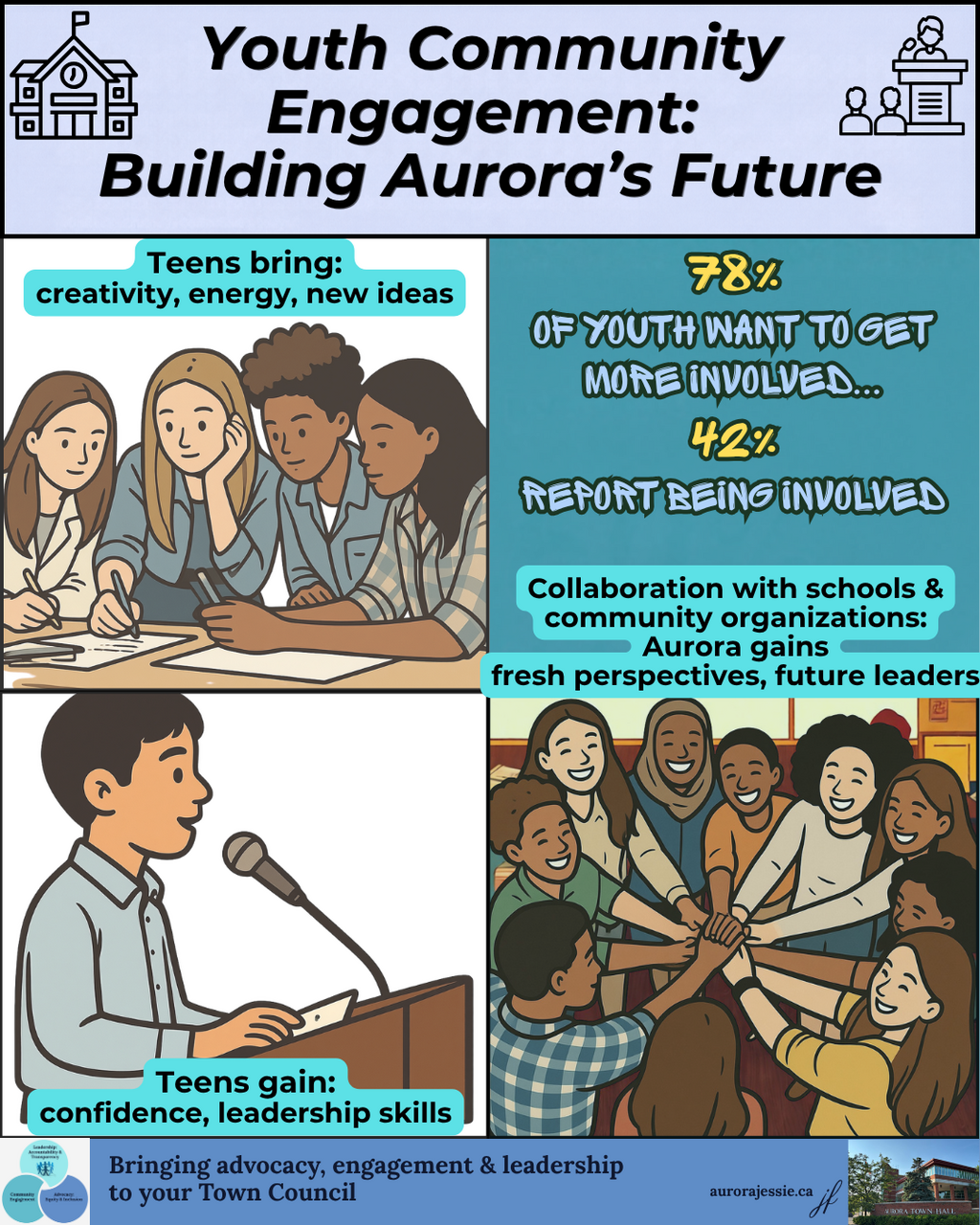
I believe youth engagement in the community is incredibly important. Youth engagement is connected to inclusion; inclusion is about everyone having a voice in decision-making, everyone having a seat at the table. Though younger community members can't vote for or serve in municipal government, they can certainly have a voice.
Aurora does an outstanding job of providing a wide variety of programs, recreational, and leadership opportunities for teens and has even earned provincial recognition as a Platinum Youth Friendly Community for its youth engagement and recreation opportunities, which I’m proud to say I played a very small part in helping to achieve during my years involved in youth programs and serving on the Parks and Recreation Advisory Committee. However, there is currently little youth involvement in civic matters, and this is something I would like to change.
I’ve been working with teens since I was a teen myself - in youth sports, in local schools, in leadership training, and in programs supporting at-risk youth. I believe it’s important for young people to be engaged and involved with the community - both for the community and for themselves. Young people are the future of the community. Younger residents bring energy, creativity, and new ideas to the table, providing a broader base of perspectives for community decision-making, and community involvement gives young people the opportunity to develop leadership skills that will serve well them later in life.
According to Statistics Canada, 78% of Canadian youth want to get more involved and make a difference in their local communities, but only 42% report being actively involved because of barriers like availability and cost.
As Councillor, I will collaborate with local high schools to provide opportunities for students to learn about & participate in municipal governance & local community organizations to offer youth leadership opportunities. Want more details? Check out my YouTube channel!
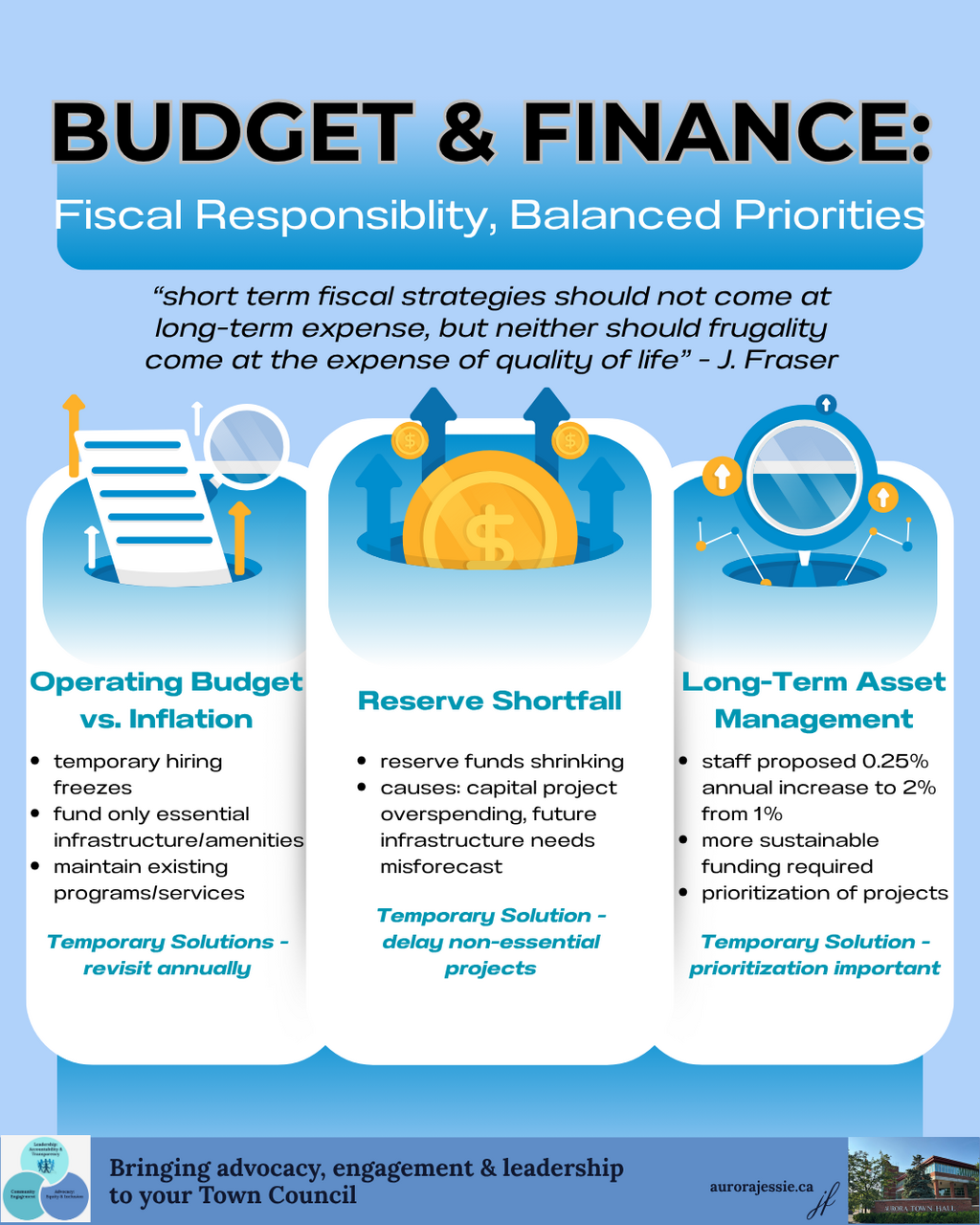
Fiscal Responsibility: Budget & finance are key concerns for residents.
Operating Budget & Inflation: I agree with the current pathway that includes temporary hiring freezes, reducing discretionary spending, and funding only essential infrastructure & amenities in response to the pressures of inflation so that we can maintain existing programs & services. However, these are not long-term solutions; we will need to revisit them annually in the next term of coucil with relation to the existing 10-year capital plan.
Asset Management & Reserve Shortfall: the last round of committee & countil meetings in the spring clearly highlighted that the Town's reserve funds are shrinking dramatically; they're projected to his their lowest point in the next few years, during the next council term. Since the main causes of this decline are capital projects being mis-estimated or running over budget and future infrastructure needs not being accurately forecast, these are areas that need critical consideration in the next budget which will likely need to mean delaying non-essential projects.
A Long-Term Asset Management Funding Strategy was proposed by Town staff for the next council to consider that involves a 0.25% increase per year to 2% from the current rate of 1% to address the backlog of asset management until more sustainable funding can be secured, an idea which I think is worth deeper consideration.
Either way, prioritization of projects will be important. In general terms, I prioritize responsible budgeting that considers fiscal responsibility while still balancing priorities related to infrastructure and service levels.
Short term fiscal strategies should not come at long-term expense, but neither should frugality come at the expense of quality of life. Want more details? Check out my YouTube channel!
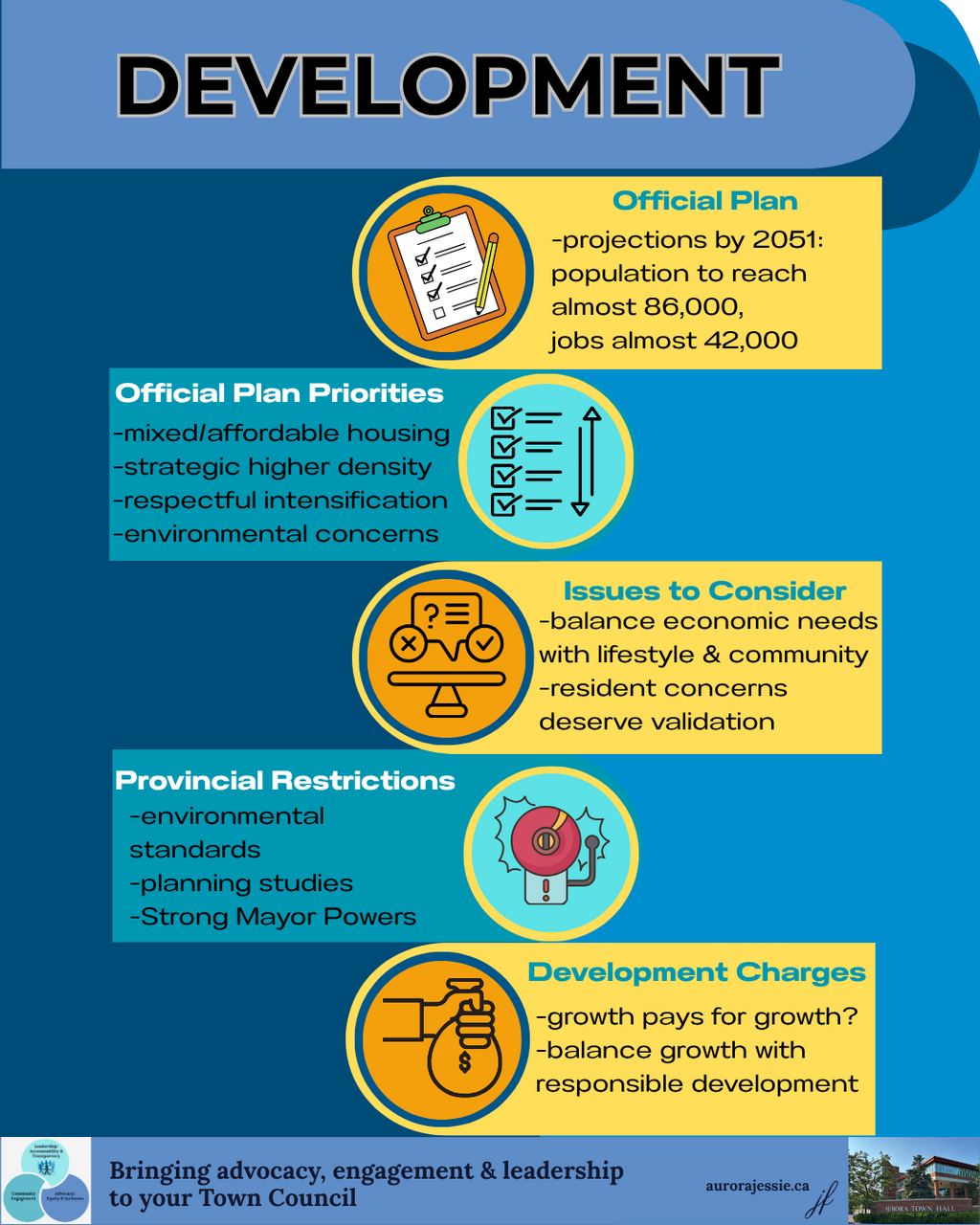
Residential Development: Key issues relate to intensification & overdevelopment. There are real concerns around development that places more homes and residents into existing space: supporting infrastructure, transportation and traffic, and environmental concerns.
The Town’s existing Official Plan that manages growth & development has our population projected to reach almost 86,000 by 2051. This plan prioritizes mixed & affordable housing; strategic growth where higher density makes sense like near the GO station; intensification that respects existing neighbourhoods and preserves historical properties; and environmental concerns. Development is necessary to accommodate population growth and ensure financial stability & sustainability of infrastructure. But this growth needs to be thoughtful & careful, balancing economic necessity with lifestyle & community.
Currently, there are over 30 community developments & infill projects under review in town; but some - the Heathwood Heights infill, the Yonge & St.John’s mid-rise, the Wellington East townhouses - have significant pushback related to traffic, access, and infrastructure strain. Current resident concerns deserve validation when planning for growth. The province has created legislation intended to speed up construction, reduce costs, and minimize municipal red tape, but there are negatives, like the restriction on planning studies and enforcing environmental standards that extend beyond provincial baselines. Strong Mayor Powers were also introduced as part of the province’s housing-related priorities, but have not been successful in accelerating development yet in Aurora.
Development charges are relevant, too - the fees that builders are charged for permits that help finance infrastructure. The federal & provincial governments created a funding initiative to reduce these charges to help lower housing costs, but Aurora opted not to participate because of the budget shortfall it would create, shifting the burden of infrastructure financing off developers and onto residents through property taxes - with no guarantee of affordability. This “growth should pay for growth” strategy is sound, but affordability remains critical.
This is where balance becomes important: affordable housing means higher density housing; higher density housing requires infrastructure; infrastructure costs and requires growth to pay for it. We need to balance the need for growth with responsible development that recognizes what makes Aurora unique. Want more details? Check out my YouTube channel!
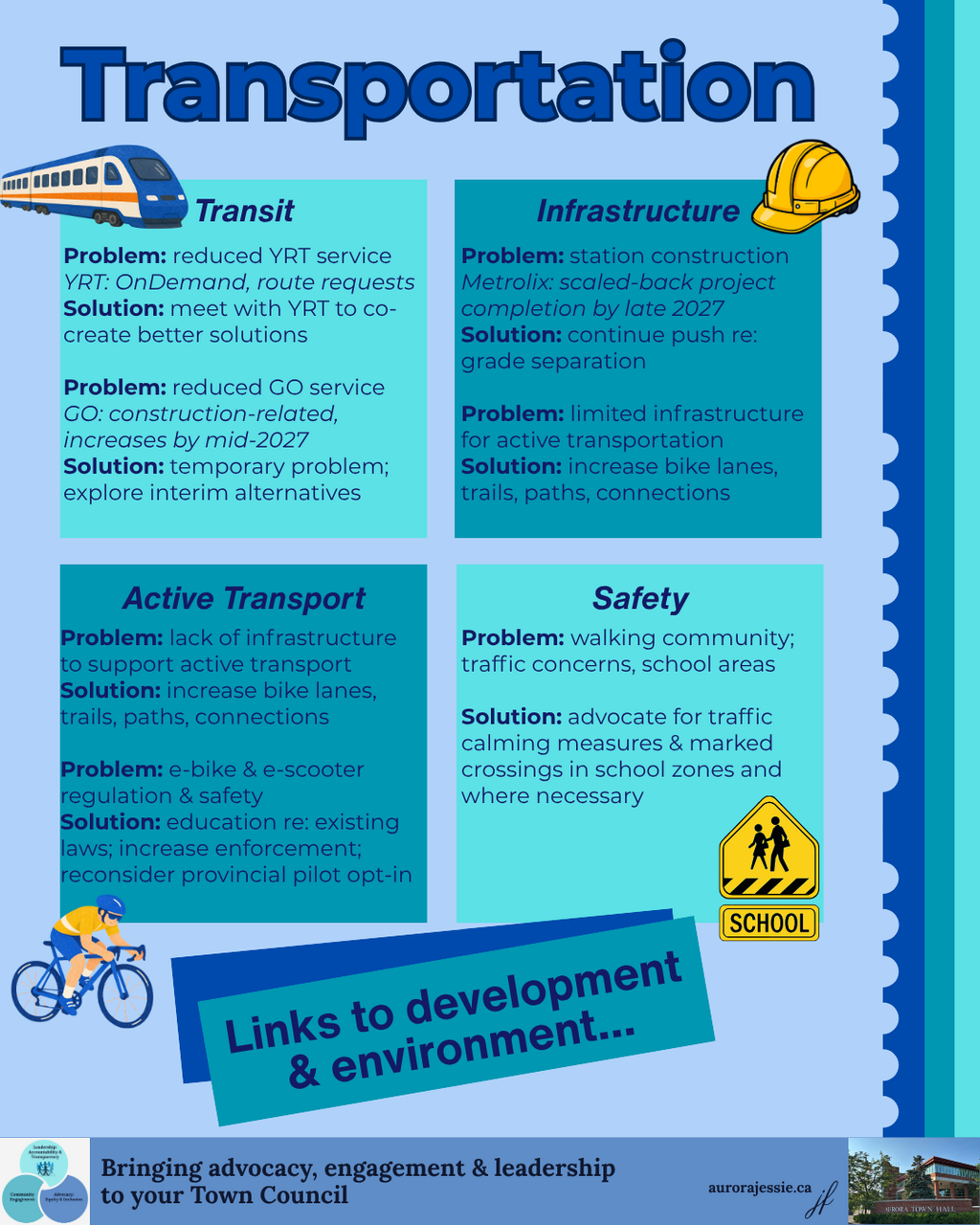
Transportation concerns in Aurora include those related to transit - both YRT and GO - transportation-related infrastructure, active transportation options, and safety.
Transit concerns relate to frequency of service. During the pandemic YRT reduced service and some lines did not return. YRT is advising riders to use the On-Request model & submit route requests to be recorded for future planning. As Councillor, I will meet with YRT management to co-create better solutions for Aurora. GO transit concerns also relate to the drop in frequency of trains as well as the seemingly never-ending construction at the Wellington GO station. Good news: these schedule adjustments are temporary during the Barrie line construction and we will actually see long-term increases in daily service both ways by mid-2027. Current projections for the scaled-back project completion are late 2027, but the grade separation portion of the project being put on hold is concerning given potential traffic disruptions.
Active transportation & infrastructure is also a concern; for transit & active transportation to be encouraged, safe road & trail connections need to be created & maintained. If the infrastructure to support alternate means of transportation is not available, residents can't use them. E-bikes and e-scooters are one form of alternate transportation that is being used lately - and that is problematic, too. Though they can be a great alternative to cars, usage needs to be better regulated. There are laws in place for both that include speed maximums, no sidewalk usage, and no users under 16 years old; and for e-scooters, no use is permitted ANYWHERE, for any age, other than on public property. Enforcement of these laws is challenging from a resource perspective, so education & communication are key: educating residents on the existing regulations and providing ongoing communication as guidelines change. I do think it’s worth considering whether Aurora should pass a bylaw (and opt into the provincial pilot program) allowing e-scooters as an alternative form of transportation that is more accessible and environmentally friendly; however, until change is legislated, greater enforcement of existing laws is necessary to keep people safe on our streets and trails.
Transportation safety in our neighbourhoods is a concern for Ward 5 families: we are a walking community and traffic safety measures are important for our children’s safety, especially during the school year. As a candidate with an intimate knowledge of the high pedestrian traffic routes in Ward 5 - having walked my kids to & from these schools for two decades - I will advocate for more traffic calming measures & marked crossings. Want more details? Check out my YouTube channel!
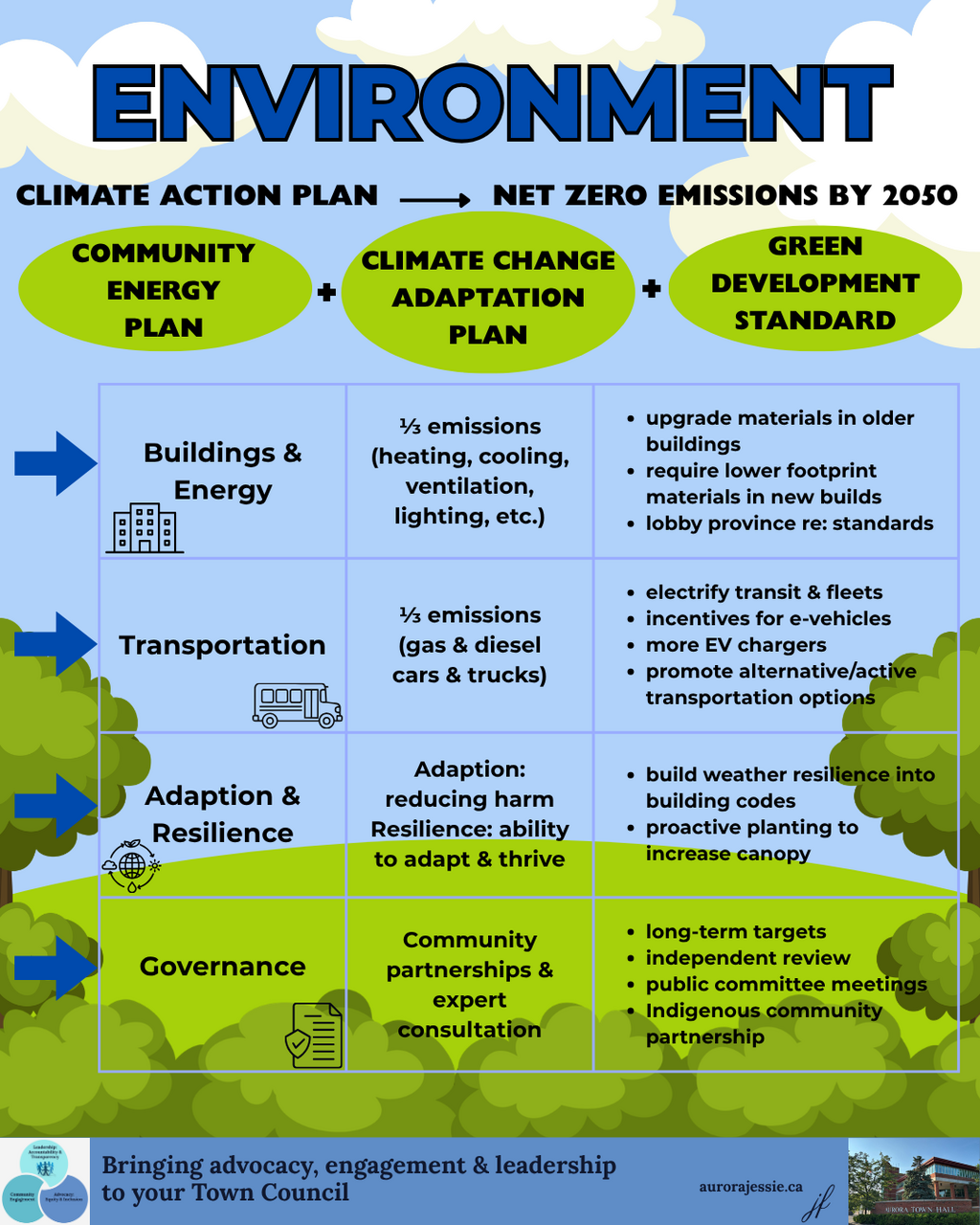
Aurora’s climate action plan mirrors the regional, provincial, and national plans with a goal of net-zero emissions by 2050. Meeting this target will require managing energy use and making changes related to buildings, infrastructure, transit, and natural assets.
Aurora's Community Energy Plan outlines strategies for energy use and reducing emissions; the Climate Change Adaptation Plan helps manage & mitigate climate risk & resilience in infrastructure and operations; and the Green Development Standard sets building requirements for energy efficiency. However, projections based on these current measures do not have us meeting our target. So what can we do?
Buildings and Energy account for more than ⅓ of greenhouse gas emissions. Actions I’d like to consider are upgrading materials like insulation, furnaces, windows, etc. in older buildings and requiring lower-footprint materials like solar energy & recycled steel and stricter codes in new builds; unfortunately, the provincial government restricts enforcing environmental standards, so I would advocate for lobbying the provincial government to change that standard.
Transportation causes another ⅓ of emissions - primarily from gas & diesel cars & trucks. To offset this we should be making an effort to move to electrification: electrifying transit and municipal fleets, increasing incentives for residents to purchase e-vehicles, and increasing availability of EV chargers. We can also improve transit and promote alternative & active transportation; however, this requires infrastructure to support those options like paths, lanes, and safe connections.
Adaption & Resilience are also important: adaption considers actions to reduce harm from climate impacts, while resilience looks at ability to bounce back, adapt, and thrive after an event. Actions that I will advocate for as Councillor will be to build resilience into our building codes to survive future weather events, and to improve and increase our green infrastructure through proactive planting.
As Councillor I will advocate for long-term binding targets and frameworks to meet those targets; regular review of progress by independent environmental advisory bodies; regular public forums & committee meetings to assess and review progress and findings; and reciprocal partnership with local Indigenous communities, whose wealth of knowledge about our land is a resource we should be sharing if they are willing. Want more details? Check out my YouTube channel!